

Marking and identification of contents in pipes and piping systems is important for both safety and maintenance. Pipe markers are used to visibly identify contents, flow directions, and hazard classification, thus promoting a safe working environment. Use the below legend and information to help you choose the correct pipe marker for your application.
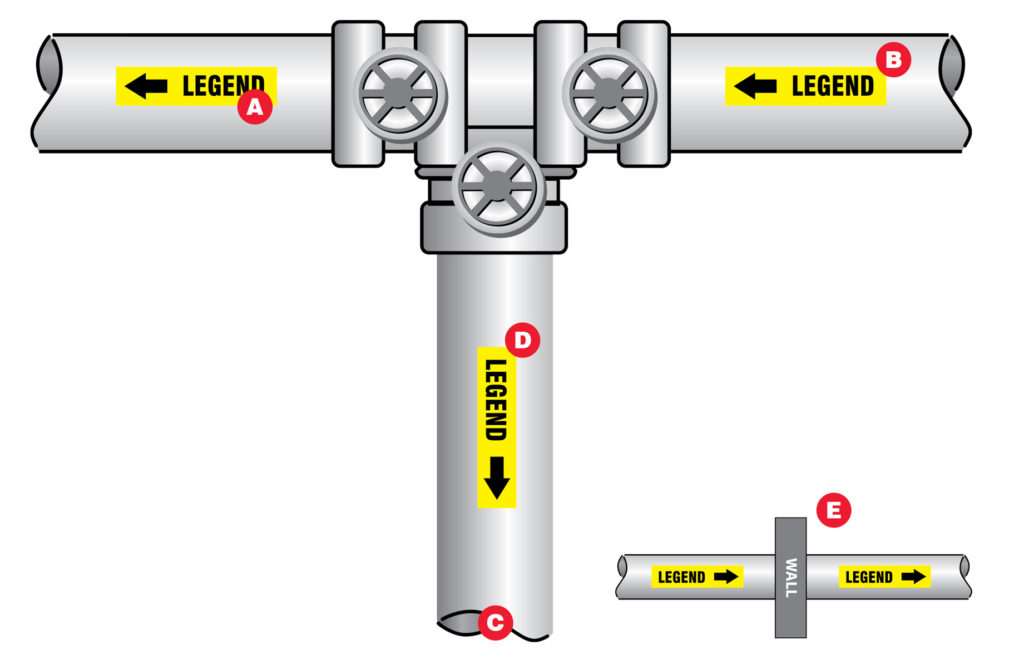
The legend on the marker gives the name of the contents in full or abbreviated form. Arrows should be used to indicate direction of flow.
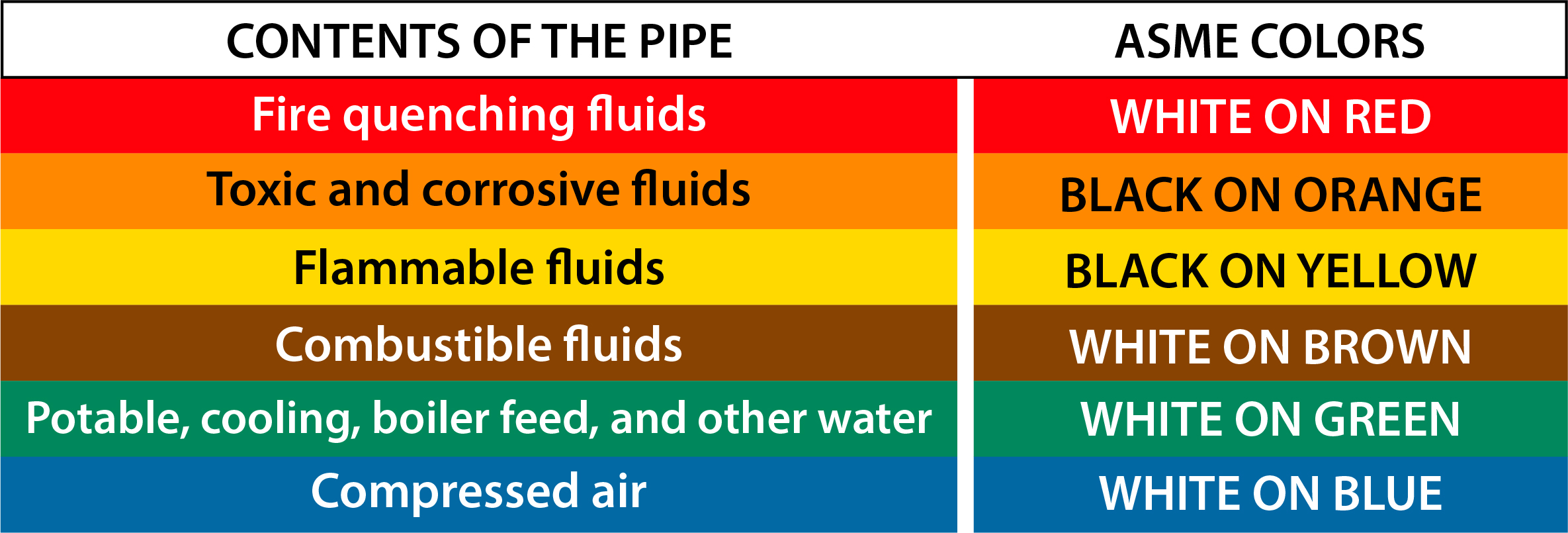
Colors can also identify the hazardous character of the contents in the pipes. ASME A13.1-2007 Scheme for the identification of Piping Systems states that a uniform system for the identification of piping contents has been established to warn personnel when the piping contents are inherently hazardous. This standard has been prepared to specify the identification of the contents of piping systems on the basis of legends, it also suggests the use of color as a supplementary means of identifying the type of hazard of the material contained in the system. Below are the colors that ASME recommends:
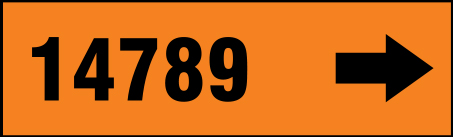
Pipe outside diameter, including insulation, determines the letter height and the length of pipe marker color field.
| Outside Diameter of Pipe |
Length of Pipe Marker Color Field |
Size of Letters |
| ¾ to 1-¼" | 8" | ½" |
| 1-½ to 2" | 8" | ¾" |
| 2-½ to 6" | 12" | 1-¼" |
| 8 to 10" | 24" | 2-½" |
| Over 10" | 32" | 3-½" |
Choose the correct material to fit the application.

Pipe markers are used to visibly identify contents, flow directions and hazard classification of material moving through pipes. Visibility and location of the pipe markers are very important. Make sure the pipe markers can be read from a distance. Some installation recommendations are:
| Product | Surface | Material | Temperature Range |
Maximum Rec. Size |
UV Resistance |
Chemical Resistance |
Abbrasion Resistanc |
| Self-Stick Vinyl | Gloss | Laminated Vinyl | -20° to 176°F | 4-½" x 32" | Yes | Good | Good |
| Cling-Tite | Gloss | Polyester/Vinyl | -40° to 302°F | 25" x 12" | Yes | Excellent | Excellent |
| Snap Tite™ | Matte | Rigid Vinyl | -4° to 158°F | 25" x 12" | No | Good | Fair |
| Band-Strap Plastic | Gloss | Polycarbonate | -50° to 190°F | 4-½" x 32" | Yes | Excellent | Excellent |
| Big Wrap™ | Matte | Reinforced Vinyl | -4° to 158°F | 168" x 36" | No | Good | Good |
| Reflective Self-Stick | Gloss | Laminated Reflective Vinyl |
-30° to 200°F | 4-½" x 32" | Yes | Excellent | Excellent |
| Snap Tite™ Stencil | Matte | Rigid Vinyl | -90° to 168°F | 17" x 39" | Yes | Good | Good |
Additional materials are available. Please contact our Facility Identification specialist for more information.
Information provided by AccuformNMC.

September 23, 2026
Keeping your facility's Clean-in-Place (CIP) operations running smoothly is critical — especially when o...
September 23, 2026
For years, the food manufacturing and dairy processing industries have relied on "reactive control". In ...
September 17, 2026
When workers remove safety glasses mid-shift due to fogged lenses or poor fit, they create immediate exp...