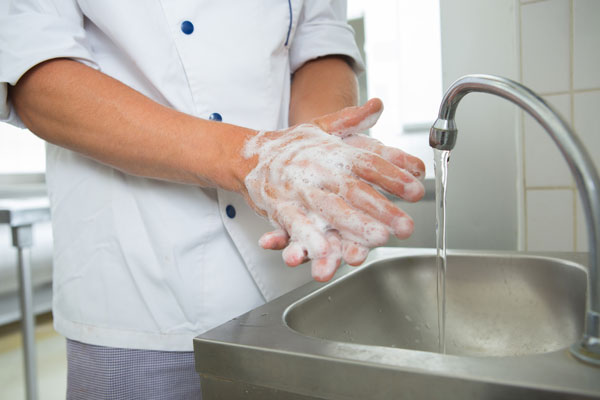

In food processing, we spend a lot of time talking about equipment, sanitation programs, and environmental monitoring — but one of the most important lines of defense against cross-contamination is also the simplest: the human hand. In honor of Global Handwashing Day on October 15, Nelson-Jameson teamed up with Best Sanitizers Inc. to sit down with Dr. James Arbogast, a PhD chemist with more than 25 years of experience in hand hygiene science and product development. We asked him to clear up common handwashing misconceptions, explain what actually makes a hand wash effective, and share practical tips food manufacturers can put to work on the plant floor. Here are three key takeaways from our conversation.
Nelson-Jameson: From a microbiological standpoint, how does washing with soap and water physically dislodge things like dirt, fats, and pathogens differently than just trying to kill them on the skin?
Dr. James Arbogast: "A good hand wash formulation, and really any cleanser, your laundry products have similar technology where you're using a surface active agent, a surfactant is the common term for that, that captures the soil, and oils, and dirt, and microorganisms, the pathogens, the germs that can get you sick. It basically encapsulates them. Think of it like capturing them in a bubble, what's technically called a micelle, and then that micelle is water-soluble, and it goes down the drain. Dish detergents work the same way, where you're getting the soil lifted off the surface. In our case, we're worried about the hands. If you use just water alone, you'll rinse off some germs, but the surfactant and the formulation can pull those germs off and take them down the drain."
Nelson-Jameson: The FDA code mentions 10 to 15 seconds of vigorous scrubbing, while CDC advice says something like 20 seconds. Based on your research on that duration, how much difference can five seconds really make?
Dr. James Arbogast: "Well, the wash time, the recommended wash time, is kind of hotly debated, as you said, and the guidance is different within the U.S, and even globally. I think it depends. So that five seconds can make a difference, especially with respect to the technique of the user. So the most important thing is getting the hand wash to fully cover the hands, especially those touch points like the fingertips. You want to fully cover that. If you do 20 seconds and you're just lightly rubbing the back of your hands, you're not really getting an effective hand wash. The science has showed one of the latest studies that I published. That 5 to 10 seconds of vigorous scrubbing, making sure you're getting all those important surfaces of your hands, especially the palms, is just as effective as a 20-second hand wash."
Nelson-Jameson: Can you talk about the zones of the hands that are most frequently missed?
Dr. James Arbogast: "I think the most common important part of the hands that's missed is the thumb. So this part of the thumb, you know, the inside part of the thumb that touches things. You use your inside your palm or surface of your fingers and your palm thumb to grab things. Those then become, because they're touching the surface, the highest risk points. Those are the ones that can transmit germs. A good technique principle to avoid that is to start this way, and then hit the back of the hands and the palm, opposite hands. Get the finger pads in the middle, capture the thumbs by rolling it this way, and then rinse effectively down the drain. The back of the hands are also fairly commonly missed. But they are the lowest risk part of the hand. So I'm more concerned with the palmar surface, finger pads, and thumbs."

Since 1995, Best Sanitizers Inc. has been delivering high-quality products and support to industries such as food processing, janitorial and sanitation, and healthcare. They remain committed to exploring innovative approaches to hand and surface hygiene, backed by rigorous practices and policies that guarantee their products perform as promised, giving you the confidence to use them with your facility’s hygiene program.
October 9, 2026
Protecting both workers and food products from cross-contamination is a daily operational mandate in foo...
September 28, 2026
Uncontained hair remains one of the most frequent physical contaminants in food processing environments,...
September 23, 2026
Keeping your facility's Clean-in-Place (CIP) operations running smoothly is critical — especially when o...

Food Safety, Sanitation, Cleaning Tools, Color Coding
Food Safety, Sanitation, Cleaning Tools, Color Coding
Food Safety, Sanitation, Laboratory
Food Safety, Laboratory, Sanitation