
Utilizing Modern Foreign Material Prevention Strategies for Food Safety

September 23, 2026
Jarrod Rice

For years, the food manufacturing and dairy processing industries have relied on "reactive control". In other words, there has been a focus on catching contaminants at the end of the line. However, to truly safeguard brand reputation and operational continuity, we must shift toward "proactive prevention." This transition isn't just a regulatory preference as we discussed in our most recent webinar alongside Detectamet; it is a strategic mandate driven by the sheer scale of the enterprise-level risks involved.

The "Elephant in the Room" remains the persistent presence of physical contaminants. Industry statistics reveal a sobering reality: nearly one in ten food safety recalls are caused by the physical presence of metal, hard plastics, or rubber. While the average cost of a single recall is estimated in the millions, as Jenna Ponshock (Director of Product Management at Nelson-Jameson) noted, the hidden costs—legal fees, irreparable brand damage, and lost production downtime—can total nearly half the cost of the recall itself.

Start Your Consultation

Our goal is to help you build a multi-layered defense strategy that closes blind spots, streamlines your audit readiness, and helps safeguard against costly recalls. 

Nelson-Jameson-employee-chatting-with-customer-holding-ipad-smiling-1
A primary driver of this risk is the "Operational Detection Gap." This is the time delay between the moment a contaminant enters the production line and the moment it is detected by end-of-line equipment hours later. This gap creates exponential waste, as entire batches must be quarantined or destroyed, forcing teams into costly root cause investigations.
 

Failure Mode Thinking: Reimagining Everyday Risks

Prevention begins with a cognitive shift known as "Failure Mode Thinking." Instead of only worrying about what might accidentally fall into the product, manufacturers must critically analyze the items they deliberately introduce into the production environment. Every item brought onto the floor is a potential failure point if it is lost, damaged, or enters the product stream.

Everyday Threats in the Production Environment:

  • Pens and stationery
  • Scrapers and scoops
  • Zip ties and engineering components
  • PPE (gloves, hairnets, etc.)
  • Cleaning equipment

The core of Failure Mode Thinking is recognizing that a "standard office item" is a liability in a high-risk food environment. Consider the common pen. Every facility needs them for QA and engineering, but choosing a purpose-built, detectable alternative is a strategic decision rather than a simple procurement task. By selecting tools that incorporate metal detectability, X-ray visibility, and food-safe materials, facilities gain their first layer of control. Once these risks are identified, they must be managed through a structured methodology: The Five-Step Model. (Watch the webinar to see the full five-step model!)

See the Webinar On-Demand

Join our deep dive into bridging the gap between traditional foreign material control and modern prevention, and a Q&A session.

Operationalizing the Environment: Standardization and Protection

Individual product selection is the "shield," but the production environment is the "fortress." To move toward total prevention, we must operationalize the space itself. This includes environmental tools such as detectable tote and buggy covers, which protect ingredients from falling debris during transit.

Furthermore, standardization across multiple facilities is a powerful tool for mitigating enterprise-level risk. By establishing a consistent standard for which pens, scrapers, and PPE are used at every site, companies simplify purchasing and make employee training more effective. When a "good practice" is identified at one plant, it should be codified across the organization to prevent unsuitable alternatives from creeping back into the production stream.

Strategic Partnership & Actionable Resources

Foreign material prevention is not a "one-size-fits-all" approach; it requires a tailored strategy based on your unique operational flow. Nelson-Jameson and Detectamet facilitate these high-level changes through consultation and specialized resources.

Expert Offerings:

  • Custom Assessments: On-site or virtual evaluations of your facility's operational flow to identify hidden gaps.
  • The Metal Detectable Catalog: A comprehensive resource for stationery, PPE, and specialized material handling tools.
  • Free Sample Program: Test products in your specific environment, such as Cryo-ink pens for cold-storage verification.

Is your facility prepared for the next audit? Click here to request your consultative assessment or download the Nelson-Jameson Metal Detectable Product Catalog to explore our full range of prevention-focused solutions.


Jarrod Rice

PR, Media Manager

Recent posts

Worker Safety

September 17, 2026

A Guide to Eye Protection for Food Manufacturers

When workers remove safety glasses mid-shift due to fogged lenses or poor fit, they create immediate exp...

Food Safety

September 15, 2026

How Nelson-Jameson Supports Food Safety

Food safety doesn't start on the factory floor. It starts deep in the supply chain. We know because our ...
Food Safety

September 3, 2026

A Food Manufacturer's Guide to Managing Hand Safety Risks

Hand safety isn't just about injury prevention; it's your first line of defense against cross-contaminat...

Related resources

Webinar
Improve Your Foreign Material Prevention Strategy

Improve Your Foreign Material Prevention Strategy

Each day, food manufacturing facilities work to eliminate loose-item risks and leverage detectable products to protect consumers and their brands from costly recalls. Metal-detectable experts from Nelson-Jameson and Detectamet take a deep dive into bridging the gap between traditional foreign material control and modern prevention.

Food Safety

Training
Aseptic Sampling Collection Training

Aseptic Sampling Collection Training

QualiTru Sampling Systems provides a training program focused on aseptic sampling, designed to teach individuals how to effectively collect samples using QualiTru equipment. The program emphasizes the significance of aseptic sampling and covers essential topics, including proper usage of QualiTru sampling equipment, techniques for collecting representative samples, methods to prevent contamination, and troubleshooting common issues. QualiTru offers various training options, such as on-site training, webinars, and online resources. Their website features a library of training videos and materials covering a wide range of topics related to aseptic sampling. Additionally, they provide customized training programs tailored to meet your specific needs.

Food Safety, Laboratory

Assessment
Training
Color-Coded Training & Site Assessment

Color-Coded Training & Site Assessment

Recognize and address possible hygiene and sanitation challenges based on the cleaning and material handling equipment available in your facility.

Through a discovery call, virtual, or on-site assessment, Vikan SQF Practitioner certified specialists will assist in confirming that your system and cleaning tool inventory aligns with your risk management objectives while pinpointing any missing tools and enhancing maintenance and usage practices. Evaluate whether your existing tools are utilized in the most effective manner, or determine if a more suitable tool exists for the task at hand. Ensure that your tools comply with all relevant standards and regulatory requirements. Site evaluations encompass a summary survey, an overview of the location, a color-coded factory layout plan, product suggestions, a recommended order form, and a proposal for a follow-up survey.


Food Safety, Sanitation, Cleaning Tools, Color Coding
Program Catalog
Color-coded Program Catalog

Color-coded Program Catalog

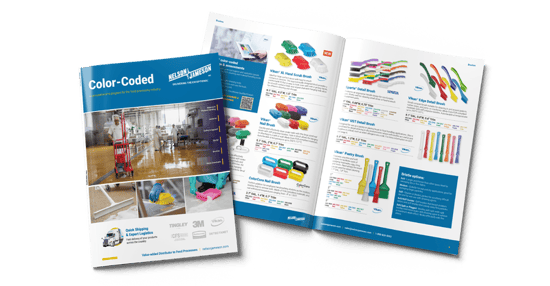
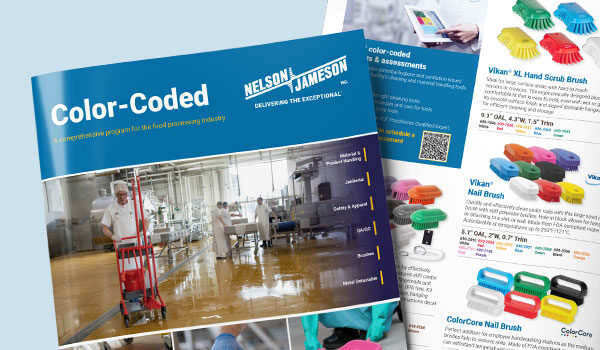
This is a comprehensive program for the food processing industry. Nelson-Jameson brings together the most extensive collection of color-coded products for material handling, product handling, janitorial, safety, apparel, QA/QC, and metal-detectable applications. With the right pieces, a color-coding system is a powerful tool in preventing cross-contamination of allergens and food-borne illnesses that can lead to sickness or expensive product recalls.

Color-Coded-Catalog_Open-Magazine-Mockup-1-1

Food Safety, Sanitation, Cleaning Tools, Color Coding